
✕
September 22, 2025
Kumar Mallampalli

ERP fatigue is real. For years, the same features have rotated through headlines; AI, blockchain, AR, rinse and repeat. But if you are in manufacturing, automotive, or construction, you are not buying buzzwords; you are buying control, clarity, and tangible outcomes.
Let’s cut past the hype. Here is what really matters in a modern ERP system in mid-2025, especially if you are running complex production lines, coordinating multi-tier supply chains, or managing project-heavy ops.
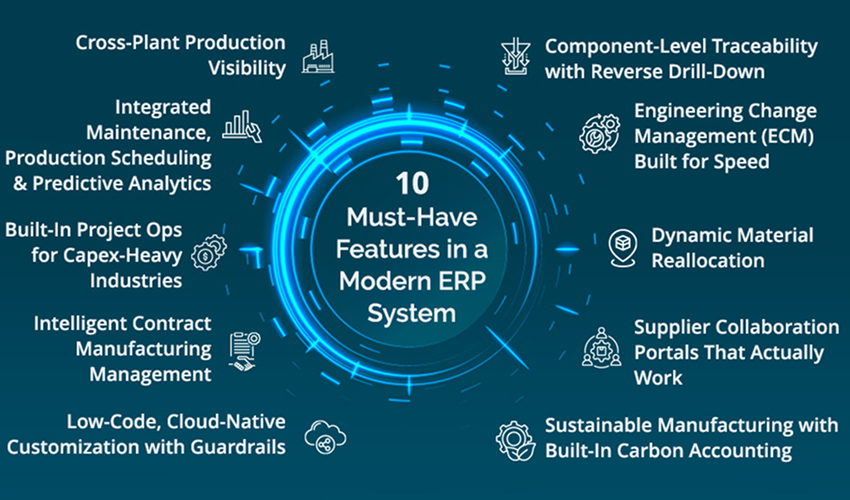
Gone are the days when serial number tracking was enough. Today’s ERP must track every component’s lifecycle, both forward and backward. If a quality issue emerges, you should be able to trace it not just to the assembly line, but back to the supplier’s supplier. Modern ERPs embed this into BoM, inventory, and service modules without making users dig through reports. The best systems offer visual traceability maps and real-time alerts, not just historical logs.
Why it matters: automotive recalls or construction material audits, this level of granularity isn’t optional, it is survival.
Too many systems bolt on ECM as an afterthought. In manufacturing, engineering change requests, approvals, and implementations need to be native, not forced. And it must sync across design, production, and procurement instantly.
Think: When a supplier can’t deliver a spec part, can your ERP instantly reroute the entire BoM through change control before downtime hits?
Example: A Tier 1 automotive supplier was able to reduce change cycle time from 2 weeks to 2 days using a fully embedded ECM.
An intelligent ERP should optimize material distribution by:
Construction Application: a shipment is delayed, the system should identify alternative suppliers before project timelines are affected.
An intelligent ERP should optimize material distribution by:
Construction Application: a shipment is delayed, the system should identify alternative suppliers before project timelines are affected.